
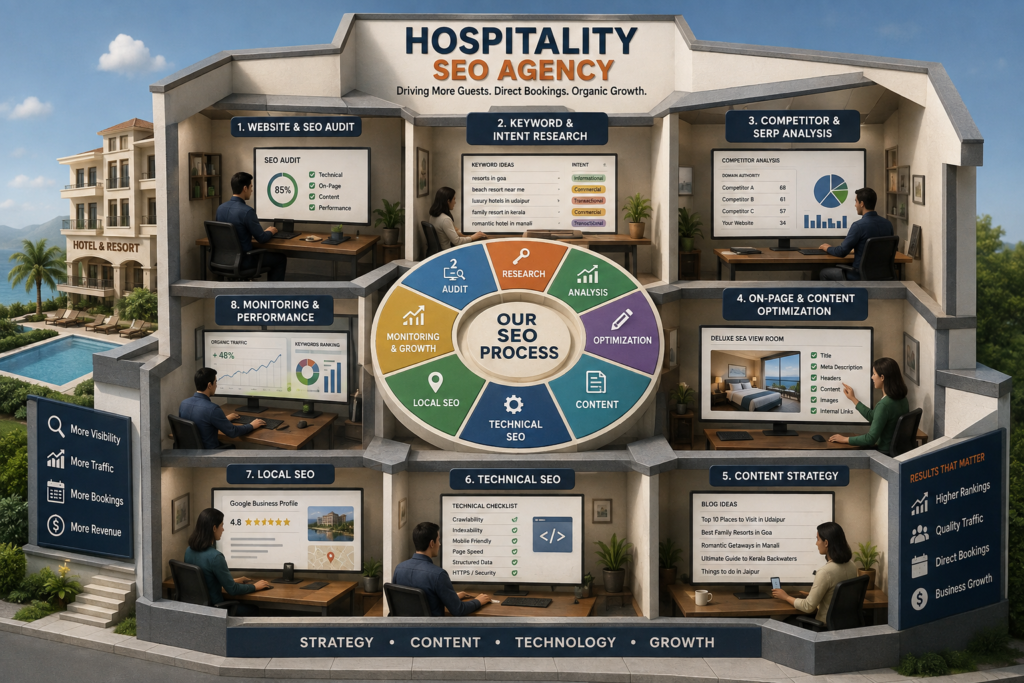
Hospitality SEO is the process of improving hotel, resort, homestay, villa, and other hospitality websites so they can appear prominently when potential guests search for accommodation, destinations, amenities, and travel-related information on search engines.
Unlike general SEO, hospitality SEO focuses heavily on location-based searches, accommodation-related queries, destination intent, booking journeys, local visibility, and seasonal travel demand. The objective is not simply to increase website traffic, but to attract users who are more likely to research, enquire, and book a stay.
Searches such as hotels near me, resorts in Goa, best hotels in Jaipur, family resorts near Delhi, or luxury hotels in Udaipur often have strong commercial or booking intent. A well-planned hospitality SEO strategy helps a property become visible at the right stage of the traveller’s decision-making journey.
Why SEO Is Important for the Hospitality Industry
Travellers usually research several properties before making a booking. They compare location, rooms, amenities, prices, reviews, nearby attractions, dining options, accessibility, and experiences.
Organic search visibility can help a property reach potential guests before they make that final decision.
An effective hospitality SEO strategy can help:
- Increase relevant organic website traffic
- Improve visibility for hotel and destination searches
- Generate direct booking opportunities
- Reduce dependence on paid advertising and third-party booking platforms
- Improve visibility in local search results
- Build authority around the property and destination
- Support seasonal and long-term demand
- Improve the overall user journey from search to booking
The focus should therefore be on attracting qualified search traffic rather than traffic volume alone.
Optimisation for AI Search and Answer Experiences
Search behaviour is increasingly moving beyond traditional blue-link results.
Users may receive answers through AI-generated search experiences, featured snippets, conversational search, and other answer-oriented interfaces.
Hospitality content can improve its usefulness for these experiences by providing:
- Direct answers to common questions
- Clearly structured information
- Concise definitions and explanations
- Well-organised headings
- Relevant FAQs
- Factual and up-to-date information
- Strong contextual relationships between pages
- Original and experience-based insights
This does not mean creating content specifically to manipulate AI systems. The foundation remains the same: provide clear, trustworthy, useful information that satisfies the traveller’s search intent.
Performance Monitoring and Continuous Optimisation
SEO is an ongoing process rather than a one-time website activity.
Performance should be regularly monitored using data from sources such as Google Search Console, Google Analytics, business listings, ranking data, and booking or enquiry information.
What Makes Hospitality SEO Different?
Hospitality SEO requires a combination of technical SEO, content strategy, local SEO, destination relevance, user experience, and conversion optimisation.
A hotel may need to compete not only with other hotels but also with large travel platforms, destination websites, review websites, blogs, and tourism portals.
This makes it important to build a website that provides information travellers cannot easily get from a generic booking platform.
A strong hospitality SEO approach therefore focuses on the complete customer journey:
Discover → Research → Compare → Trust → Enquire → Book → Return
Hospitality SEO is not simply about ranking a hotel website for keywords such as hotel in [destination]. It is a long-term process of improving technical performance, understanding traveller search behaviour, creating useful destination and property content, strengthening local visibility, improving website experience, and connecting organic search traffic with measurable business outcomes.
The strongest approach combines technical foundations, relevant content, local search optimisation, structured information, user experience, and continuous performance analysis to create sustainable organic visibility for hotels, resorts, villas, and other hospitality businesses.