
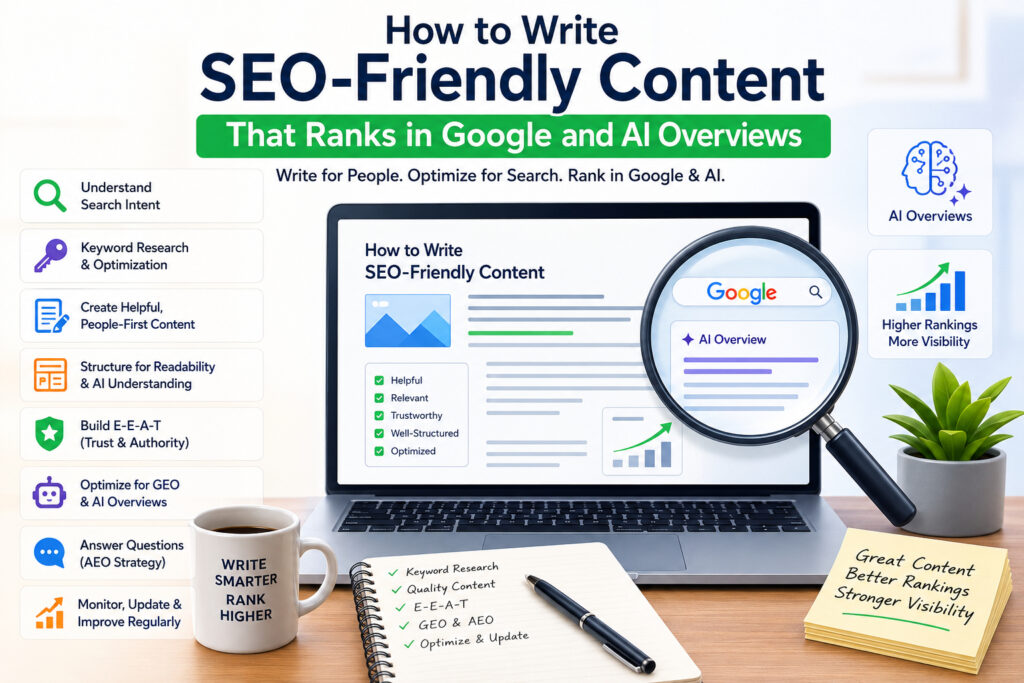
Search engine optimization has changed dramatically over the last few years. Today, simply adding keywords to a page is no longer enough. Google’s AI-powered search experience, AI Overviews, and the rise of generative search engines require content that is helpful, trustworthy, and written with genuine expertise.
If you’re focused on writing for SEO optimization, your goal should be to create content that serves users first while making it easy for search engines and AI systems to understand your expertise.
This guide explains how to write SEO-friendly content that performs well in Google Search, AI Overviews, and modern answer engines.
Why SEO Content Writing Matters More Than Ever
Google’s ranking systems now prioritize content that demonstrates:
- Experience
- Expertise
- Authoritativeness
- Trustworthiness (E-E-A-T)
At the same time, AI-powered search platforms analyze content differently than traditional search engines. They look for:
- Clear answers
- Context
- Entity relationships
- Semantic relevance
- Structured information
- Helpful explanations
Well-optimized content is no longer written just for ranking—it is written to become the best answer available.
Start with Search Intent
Before writing a single paragraph, understand why someone is searching.
The four primary search intents include:
Informational
Example:
“How to write SEO-friendly content”
Commercial
Example:
“Best SEO writing services”
Transactional
Example:
“Hire SEO content writer”
Navigational
Example:
“Google Search Console guide”
Your content should completely satisfy the user’s intent instead of trying to target too many topics on one page.
Perform Smart Keyword Research
Modern keyword research goes beyond search volume.
Look for:
- Primary keyword
- Long-tail keywords
- Question-based keywords
- Related searches
- Semantic keywords
- Topic clusters
For this article, the primary keyword is:
writing for SEO optimization
Related terms naturally include:
- SEO content writing
- optimize blog content
- Google ranking factors
- AI Overviews
- GEO optimization
- content marketing strategy
Use keywords naturally throughout the content instead of forcing them into every paragraph.
Create Helpful, People-First Content
Google rewards content that solves problems.
Ask yourself:
- Does this answer the user’s question?
- Is the information accurate?
- Does it provide practical value?
- Is it more useful than competing articles?
Instead of writing generic advice, include:
- Real examples
- Actionable steps
- Checklists
- Best practices
- Common mistakes
Helpful content earns trust, backlinks, and higher engagement.
Structure Content for Google and AI Overviews
AI systems prefer content that is easy to understand.
Use:
Clear H1 Heading
Only one H1 per page.
Logical H2 and H3 Headings
Break complex topics into smaller sections.
Bullet Lists
Lists improve readability and increase the chances of appearing in featured snippets.
Short Paragraphs
Aim for 2–4 sentences per paragraph.
Tables and Checklists
Structured information is easier for AI models to interpret.
This improves both user experience and machine readability.
Demonstrate E-E-A-T Throughout Your Content
Google evaluates the credibility of your content.
Strengthen E-E-A-T by:
- Sharing first-hand experience
- Including author information
- Citing reliable sources where appropriate
- Updating content regularly
- Providing accurate and verifiable information
- Avoiding exaggerated claims
For business websites, include:
- About page
- Contact details
- Privacy policy
- Case studies
- Testimonials
These trust signals help improve perceived authority.
Optimize for GEO and AI Search
Generative Engine Optimization (GEO) focuses on helping AI search engines understand your content.
To improve GEO:
- Answer questions directly.
- Use natural language.
- Cover topics comprehensively.
- Explain concepts clearly.
- Include definitions.
- Add contextual examples.
- Use descriptive headings.
- Build topical authority with related articles.
AI search engines often summarize content rather than display only links. Comprehensive, well-structured pages are more likely to be referenced.
Optimize for AEO (Answer Engine Optimization)
Answer engines look for concise, direct responses.
To improve AEO:
- Answer the main question in the first paragraph.
- Include FAQ sections.
- Use conversational language.
- Add definitions.
- Write short summary paragraphs.
- Cover “People Also Ask” questions.
- Use schema markup where applicable.
This increases your chances of appearing in voice search and AI-generated answers.
Improve On-Page SEO
Every blog should include:
- Optimized title tag
- Compelling meta description
- Keyword-friendly URL
- Image alt text
- Internal links
- External references (when appropriate)
- Fast page loading
- Mobile-friendly design
- Optimized Core Web Vitals
Technical SEO supports great content by ensuring it is easy to crawl and index.
Update and Refresh Existing Content
SEO is an ongoing process.
Review your content regularly to:
- Refresh statistics
- Add new information
- Improve readability
- Expand thin sections
- Answer emerging user questions
- Optimize for new AI search trends
Updated content often performs better than newly published pages because it retains existing authority while remaining relevant.
Final Thoughts
Writing for SEO optimization in 2026 is about creating content that benefits both people and intelligent search systems. By understanding user intent, demonstrating E-E-A-T, optimizing for Google Search, AI Overviews, GEO, and AEO, you can build content that earns visibility, trust, and long-term organic traffic.
Rather than focusing solely on keywords, invest in creating comprehensive, authoritative, and user-focused content. This approach not only improves rankings but also increases the likelihood that your content will be cited in AI-generated search results and answer engines.
FAQs
1. What is writing for SEO optimization?
Writing for SEO optimization is the process of creating content that helps search engines understand your page while providing valuable, relevant information to users. It includes keyword research, content structure, readability, and technical optimization.
2. How does E-E-A-T improve SEO rankings?
E-E-A-T (Experience, Expertise, Authoritativeness, and Trustworthiness) helps Google evaluate the quality and credibility of content. Strong E-E-A-T signals can improve visibility for competitive and high-value search queries.
3. What is GEO in SEO?
Generative Engine Optimization (GEO) is the practice of optimizing content so AI-powered search engines can easily interpret, summarize, and reference it in AI-generated responses.
4. How is AEO different from traditional SEO?
Answer Engine Optimization (AEO) focuses on creating direct, structured answers for voice assistants, featured snippets, and AI-powered search experiences, while traditional SEO primarily targets organic search rankings.
5. What are the best practices for SEO-friendly content?
The best practices include understanding search intent, using relevant keywords naturally, creating high-quality original content, following E-E-A-T principles, optimizing headings and metadata, improving readability, and regularly updating your content to maintain relevance.